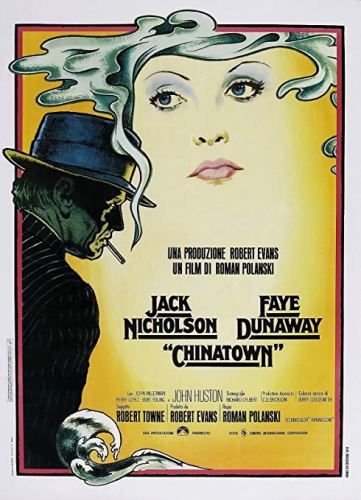
Chinatown (1974) is a movie that comes up time and again in discussions of strong screenplays. It’s a “neo-noir mystery film” starring Jack Nicholson and Faye Dunaway.
Even for older movies, I try not to talk about endings unless I have a good reason to, but I think I have to here — I think the ending is what will end up making the movie so memorable to me: everything goes from bad to worse really fast, Evelyn Mulwray is killed, Cross gets away with everything including Katherine, and Gittes is left disillusioned and powerless.
It’s a bit coincidental that I watched this movie so soon after Watchmen, because while writing about that one I mentioned that “bad guy wins” outcomes are pretty rare, and I’ve since learned that Chinatown is considered one of the most well-known cinematic examples of exactly that outcome.
And actually, Chinatown represents a much more definitive triumph of evil over good, because while Adrian Veidt’s master plan was ostensibly for the greater good, Noah Cross is a more traditional “evil” villain, almost to the point of satire by modern standards. By that I mean if Chinatown came out today I think that audiences would generally expect Cross’s motivations and internal mechanisms to be fleshed out a bit more, but sometimes simple and straightforward does work — and it seems to work here.
Similar things could be said about both Gittes and Evelyn, which is interesting because as characters they subvert a lot of the stereotypical tropes and expectations often associated with their archetypes. Gittes was shown to be not-so-tough compared to the hardboiled image of himself he wanted to project, and Evelyn was tragically redeemed after being set up as a treacherous black widow multiple times.
But it’s been three and a half decades now since the movie came out, and certain aspects of their characters felt a little dated. I guess I’m mostly thinking about the romantic relationship that developed between them. I don’t know how that relationship would have been perceived originally, but to me it felt somewhat forced.
Going back to the downer ending and the generally grim tone, I feel as though there’s a lot I want to say about it, but it’s hard to articulate. Personally, right now at least, I want to write uplifting stories, so in that sense Chinatown is directly contrary to the type of emotion I want to convey, but I don’t think either uplifting or sobering movies are inherently better or worse.
They’re very different. I think movies like Chinatown do a better job of “sticking” to you. It’s a little like being warm or cold. A solid feel-good movie with a neat happy ending is heartwarming but in my experience it’s difficult to hold onto that warmth once you return to reality. But Chinatown and other downer movies are cold. They make me feel cold in a way that sinks deep into my bones and can take a few days to shake off.
That doesn’t sound like an experience people would want to willingly subject themselves to, but to an extent it’s all mostly vicarious and there’s something strangely fulfilling about grappling with the uglier facets of life and humanity from a safe distance. In that way watching bleaker movies is similar to watching horror but with fewer jump scares and more soul-crushing. One day I’ll be able to explain all this better, I hope.
Just one note on the plot. I think most of the mystery was put together well in that it was adequately intricate in-universe, but not too difficult to follow or understand as a viewer. The only part that felt lazy to me was that Cross’s glasses were in the pond. I appreciate them as a plot device because the misdirection with Evelyn was great (and the confrontation scene with Gittes slapping her, and her revelation was incredible) but as someone who wears glasses, it’s hard for me to buy that anyone could lose their glasses at the crime scene without noticing or doing anything about it.
You could argue that Cross was so untouchable that he knew he could leave the glasses without getting caught, but he went to quite some lengths to cover his tracks in other ways, so I don’t think he should have neglected to deal with the glasses. But I’m sure other people have addressed this before. Maybe there’s a good explanation I just haven’t thought of.
Anyway, great stuff. The next movie I’m going to write about will be even more depressing, so look forward to that.
 Tortoise+Hare Comics