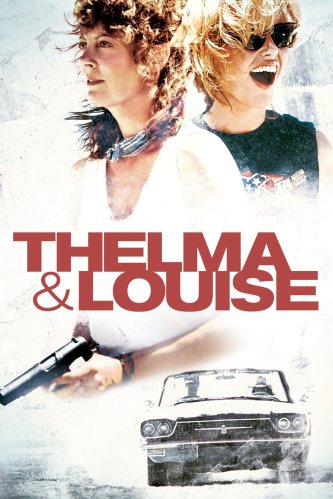
Thelma and Louise (1991) is a super well-known road movie considered to be “one of the most iconic films of the decade” according to its TVTropes page. Like Chinatown, it’s a name that comes up again and again in discussions of strong screenplays, so I wanted to watch it before I read any more spoilers about it.
The movie’s about two women who set out on a weekend vacation, and the big early twist is that Thelma nearly gets raped at a bar, Louise shoots the would-be-rapist, and the two women end up on the run from the law. The movie felt grounded and real to me, not just in terms of premise and setting but I think mostly because of the emphasis on the two characters and their interactions with each other.
I think that’s a big part of the appeal of the road genre. The characters usually go on a huge journey, but they’re also stuck in close quarters for the majority of the time, and as a result we usually get a bunch of great interaction. It’s almost like the type of setup where characters are trapped somewhere together, except less apocalyptic, so Thelma and Louise had some time to breathe and relax at times.
I found myself more interested in Thelma’s character. She felt like the main character to me, if by a small margin, and is the one who goes through the most change. Actually her arc seemed similar to Elsa’s in Frozen (2013), if the entire movie was her “Let It Go” sequence. Seeing a more repressed or reserved character get to let loose is probably one of the most vicariously satisfying sensations in cinema. It’s universally relatable.
Oh, and I loved the moment when Thelma listened to her husband for one second, knew that the police were listening, and immediately hung up. It was funny, and actually there were a bunch of great comedic moments. I don’t know if I could call the movie light-hearted, but overall it felt more upbeat than what I might have expected. I think the lighting might have been a factor. I felt there were a lot of shots of the women driving in daytime.
The contrast helped the tense moments stand out as well. For me, the scene where Thelma held the police officer at gunpoint was incredibly stressful. It felt like anything could have gone wrong at any moment, and the shift in power between Thelma and Louise was powerful. That scene also felt like the point where they truly couldn’t turn back anymore. There was a lot going on.
What Worked
I think Thelma and Louise is a great example of the rule that generally things should get worse over the course of the movie. With some movies, it’s harder to clearly see the balance of how bleak or hopeful the situation is, but here, I think it’s pretty easy to see.
If after they killed Harlan, Thelma and Louise had immediately gone to the police, Louise might have been right and maybe nobody would have believed them, but at that point they had a good number of people on their side and things wouldn’t have been “that” bad. But as they got into progressively more trouble, usually thanks to Thelma, they crossed a series of lines until they found themselves locking that policeman into the trunk of his car, and then ultimately with no perceived choice but to drive into the Grand Canyon.
A straightforward demonstration of raising the stakes.
What Didn’t Work
I think the only component of the movie that really bothered me was the fact that they ran into the one truck driver on the road three separate times, despite having to change their plans and all the crazy things that happened on their trip.
It felt hard to believe, and as I said before I think movies are allowed one or two coincidences, but the condition there is that the coincidence had better be justified. Maybe I missed the point, but the coincidence didn’t seem to be played for humor, and if the last scene with him was important, the first two could have been removed entirely without affecting anything else much.
It would have already felt like a stretch for them to see the truck driver twice, but to have it happen three times doesn’t feel necessary to me, compared to the payoff.
 Tortoise+Hare Comics